What drives our passion!
We are working in the interfaces between Inorganic, Physical and Materials Chemistry
Research
Welcome to Team M2S!
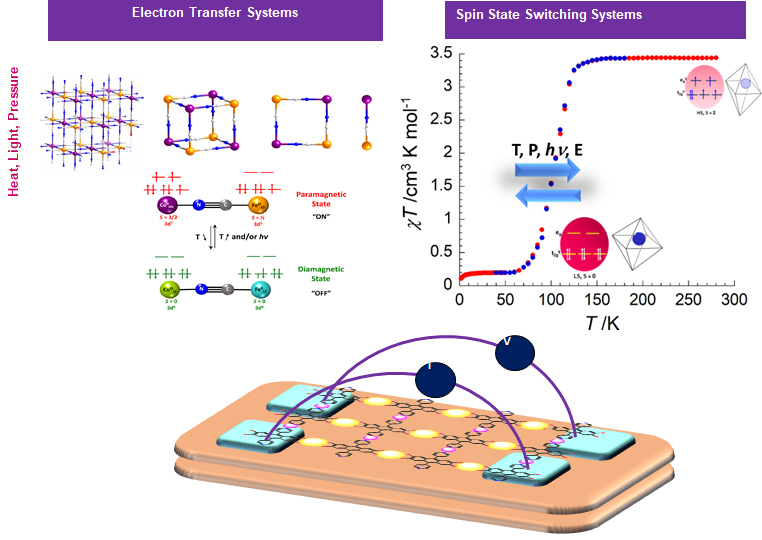
We pursue functional magnetic materials research at the interface of inorganic, physical, and materials chemistry. Our work centers on the design, synthesis, and characterization of molecular magnetic systems-including coordination complexes, spin-crossover materials, single-molecule magnets, and hybrid nanostructures-engineered to exhibit controllable spin states and advanced magnetic functionality.
Through precise control of ligand fields, exchange pathways, and intermolecular interactions, we target properties such as photo- and electrically induced spin switching, slow magnetic relaxation, spin coherence, magneto-optical activity, and magnetocaloric behaviour. We employ single-crystal diffraction, variable-temperature magnetometry, spectroscopic probes, and device-level transport studies to elucidate structure–magnetism relationships across different dimensionalities.
A major research direction focuses on interface-controlled magnetism, where molecular spin units are integrated with 2D materials to form switchable van der Waals magnetic heterostructures. These hybrid platforms enable tunability of magnetism through external stimuli, cooperative magnetic ordering, and emergent interfacial phenomena.
By combining synthetic chemistry, advanced physical measurements, and interfacial engineering, we aim to develop functional magnetic materials for quantum information processing, low power spintronics, magnetic sensing, and high-density data storage.
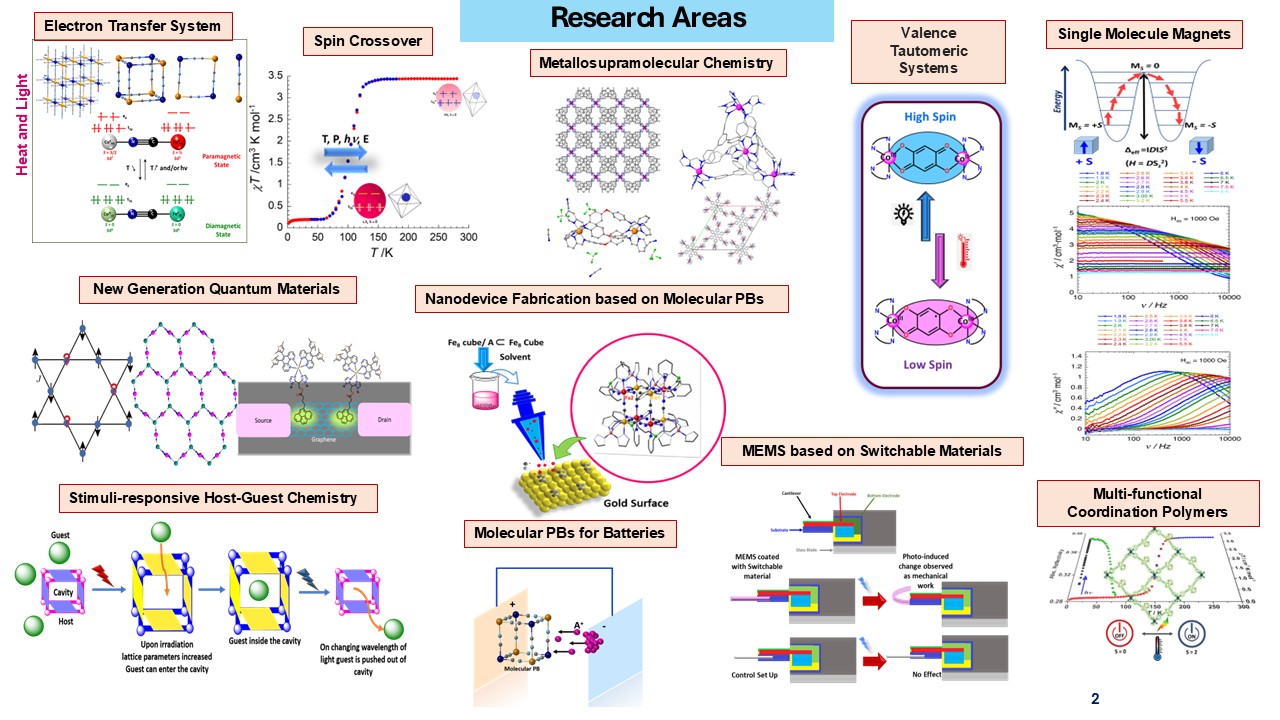
Key Research Areas in Molecular Materials & Switches.
We are working on the interface between Inorganic, Physical and Materials Chemistry. Our research focuses mainly on the rational design and synthesis of new molecular magnetic materials (organic, inorganic and nanoscale). These molecular systems exhibit several advantages such as the chemical and structural versatility, low density, solubility towards conventional solvents and possess interesting physical properties such as (Photo)magnetic, Photoluminescence, Electro- and Thermal transport, Magnetocaloric effect and Optical properties. Some of these selective materials have been used to anchor with carbon nanotubes or grafted onto silica nanoparticles for the preparation of exciting hybrid materials. Such systems offer appealing future applications for electronic devices, molecular switches and sensors, information storage and high-density recording media
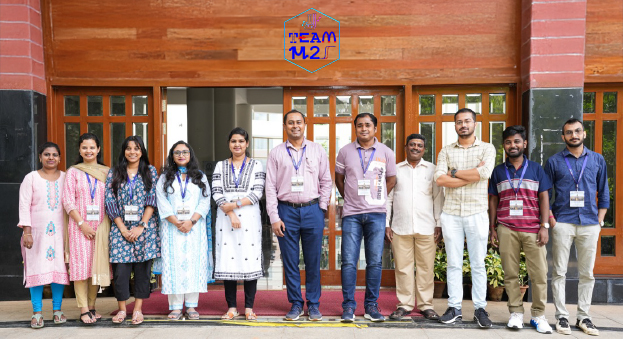
The Magnetic Materials and Switches Group, under the leadership of Principal Investigator Prof. Abhishake Mondal, brings together a vibrant team of graduate, master’s, and undergraduate students, along with dedicated research associates.
News and Update
M2SSCU
Our Recent Publications.
#79
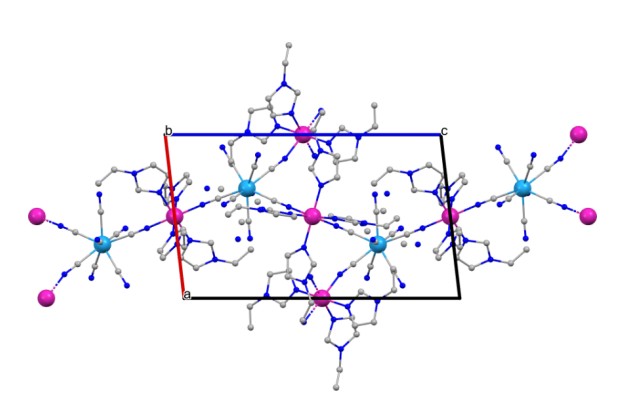
Achieving Ambient-Temperature Multiway Bistability via Electron-Transfer-Coupled Spin-State Switching in 2D Hexagonal Materials
https://doi.org/10.1002/smll.74035
2026
#78
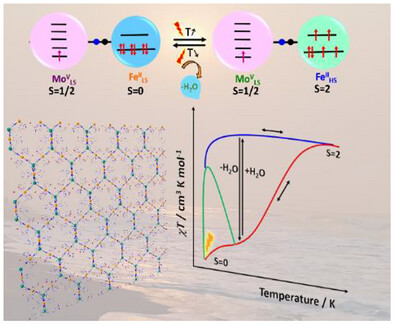
Solvent-Regulated Lattice Elasticity and Pressure-Induced Multi-Stimuli Spin-State Bistability in a Porous Hexagonal Framework
https://doi.org/10.1002/anie.9883802
2026
#77
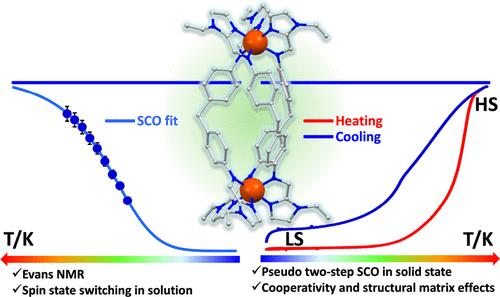
Stimuli-Responsive Spin-State Switching in Supramolecular Helicates Bridging Solid–Solution Bistability
https://doi.org/10.1021/acs.inorgchem.5c02754
2026