
Research
Home Research:
Research.
Our research focuses mainly on the design and synthesis of new Molecular Materials and Switches (MMS). The synopsis is divided into ten parts, described in the following sections to give better perspectives of our research domain.
1. Thermo-Induced Electron Transfer Systems
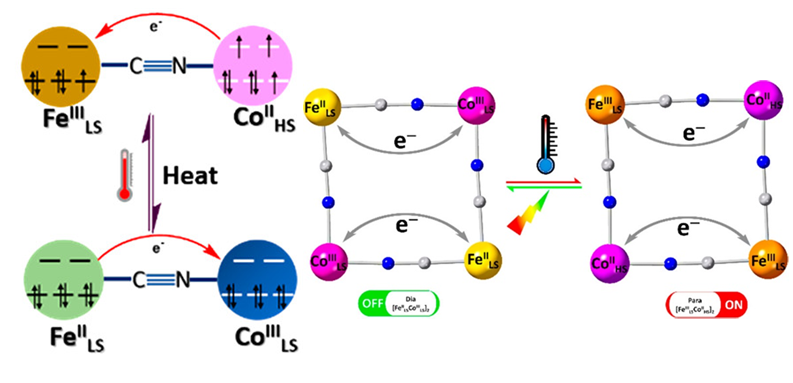
We focus on controlling electron transfer between heterometallic centers (Fe–Co, Fe–Fe, Fe–Mn) across cyanide bridges under mild external stimuli such as light and heat, enabling reversible switching without compromising structural integrity. Systems exhibiting room-temperature bistability and photomagnetic behavior represent ideal candidates for functional, switchable magnetic materials. We are working further to explore the area of Prussian blue (PB) and Prussian blue analogues (PBA) in order to design the switchable materials. These materials can pave a path for low-dimensional materials with novel functionalities and applications as multi-responsive components in future technologies.
Representative Publications:
- Chem.2020, 59, 17, 11879–11888
- Phys. Chem. A2021, 125, 22, 4775–4783
2. Spin-Crossover Systems
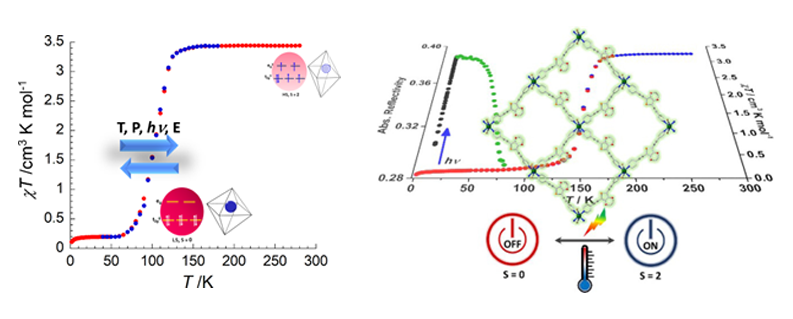
Since its discovery, the spin-crossover (SCO) phenomenon has emerged as a central concept in molecular magnetism. SCO arises from a delicate balance between the ligand-field splitting and pairing energy of transition-metal ions, allowing reversible interconversion between low-spin and high-spin states under mild external stimuli such as light, temperature, pressure, or pH. These spin-state transitions are accompanied by changes in magnetic, optical, and structural properties. Our research focuses on designing and synthesizing transition-metal complexes with d⁴–d⁷ electronic configurations to systematically explore their SCO behavior and tunable magnetic responses.
Representative Publications:
- Chem. 2020, 59, 18, 13009–13013
- Supramolecular Cage Type Complexes (integrated with photoactive ligands)
- Valence Tautomeric Systems
- Radical-based Magnetic Materials
- Organometallic Single-Molecule Magnets (SMMs)
- Photoresponsive and Switchable Metal–Organic Frameworks (MOFs)
- Molecular Machine and Rotaxane of Magnetic Materials
- Magnetic Liquid Crystals
- Molecule-based Magnetic Nanoparticles and Quantum Dots
- Photoactive Energy Materials: Perovskite based
- Pyroelectric and ferroelectric materials based on SCO systems
- Memory devices based on SCO and MMET systems